
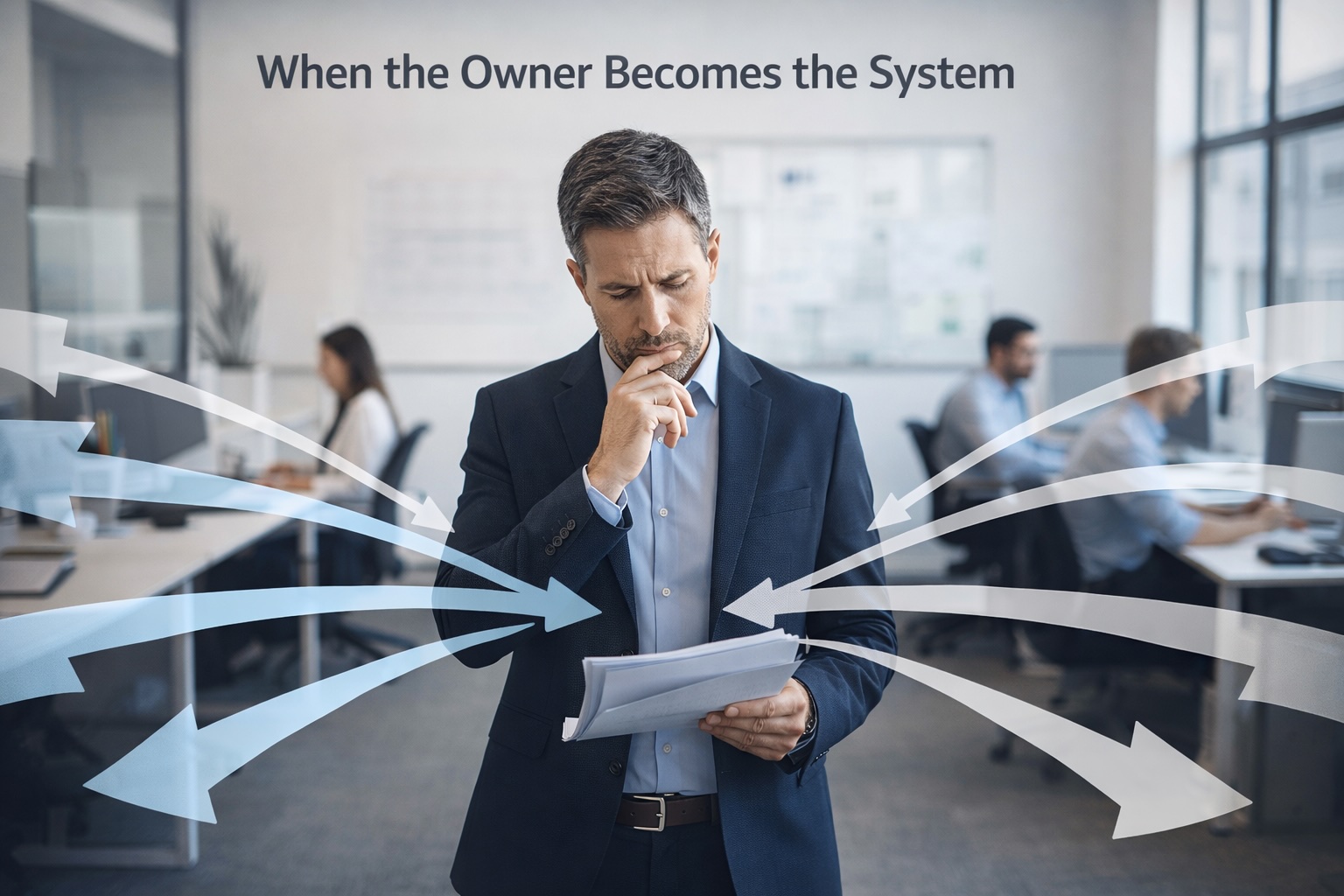
If your small business isn’t growing right now, the experience rarely feels subtle.
It feels heavy. You are extended, tired in a way that goes beyond long hours. Every week seems to require more decisions, more oversight, and more involvement than it should at this stage of your business.
You look at your team and think they should be capable of more.
They’re not bad people, not lazy people, but people who still require far more direction, clarification, and correction than you expected when you hired them.
You find yourself redoing work, stepping in to resolve issues that should have been handled earlier, or pushing projects forward that should not require your involvement at all. The business runs, but too much of it still depends on you personally keeping everything aligned.
Many owners reach the same conclusion when they hit this stage:
“I need people who can operate at my level.”
Along with that comes another common frustration: the belief that good people are simply hard to find. Many business owners say some version of the same thing: “I just can’t find good people.”
At the same time, you see other businesses doing the exact same thing you do, and some of them appear to be growing. That makes the situation even more frustrating.
From your perspective, the opportunity clearly exists. The demand exists. The only thing that doesn’t seem to scale is the team.
And that’s when many owners start asking themselves a difficult question:
Why isn’t this growing when I’m working this hard?
Why Many Small Businesses Stop Growing
Many small businesses stop growing when the owner’s expectations, decision-making processes, and standards exist primarily in their own head rather than being clearly communicated to the team.
As the company grows, employees often complete tasks without fully understanding the outcomes the owner expects. Work gets done, but not always in the way the owner imagined. This creates delays, rework, and constant oversight.
Over time, the business starts depending on the founder to keep things moving. The owner remains the person who sees the full picture, which means the team cannot move forward confidently without that involvement.
When expectations, ownership, and accountability are communicated clearly and consistently, teams begin operating with greater independence and businesses regain momentum.
The Real Challenge: Duplicating Yourself
Every growing business eventually encounters the same structural challenge.
In the early stages, everything works because the owner is personally involved in nearly every decision. Quality stays high. Clients are served well. Problems get solved quickly because the person who understands the entire business is present for almost every situation.
But growth changes the equation.
As the business expands, the owner cannot remain the decision-maker for every client interaction, project detail, or operational issue. The business has to begin functioning through other people.
In practical terms, this means duplicating your standards, judgment, and expectations across a team.
That knowledge has to move out of your head and into the business.
Most founders believe they are communicating clearly. They talk about priorities frequently, answer questions, and provide feedback when something goes wrong.
Yet much of what they know about how the business should operate still lives in their head.
That gap between what the owner sees and what the team understands quietly becomes one of the biggest barriers to growth.
Signs Your Business May Have a Leadership Bottleneck
Many owners do not realize they have reached this stage until the symptoms become constant. If several of these sound familiar, your business may be experiencing a leadership bottleneck.
You regularly redo work your team has completed.
Projects stall unless you personally step in to move them forward.
Team members wait for your approval before making even small decisions.
You feel like the only person who truly understands how the business should operate.
You often think, “I just need someone who thinks like I do.”
None of these signs mean your team is incapable. More often, they indicate that the expectations, decision frameworks, and standards you use every day have not yet been translated into systems your team can consistently follow.
Why Teams Often Appear Less Capable Than They Actually Are
When owners feel stretched thin, the natural assumption is that the team simply is not capable enough.
Sometimes that is true. Hiring mistakes happen.
But in many cases, the issue is not capability. It is clarity.
Employees often believe they are performing their roles correctly. They complete tasks, respond to requests, and handle issues as they arise. From their perspective, they are doing exactly what was asked of them.
From the owner’s perspective, however, the work can feel incomplete, slower than expected, or missing the level of ownership needed to move things forward. The owner sees the gaps immediately because they understand how everything in the business connects.
This disconnect rarely comes from a lack of effort. It usually comes from unclear expectations.
If expectations are not clearly defined, employees focus on completing tasks rather than delivering outcomes. They finish what has been assigned but do not always anticipate what needs to happen next.
As a result, the owner remains the person who sees the bigger picture, which pulls them back into operational work again and again. Over time, the business becomes dependent on the owner’s constant involvement simply to keep things moving.
The Communication Gap That Creates Stagnation
One of the most common causes of small business stagnation is the gap between what leaders assume is obvious and what employees actually understand.
Owners often believe they have communicated expectations simply because they have mentioned them before. But clarity requires more than occasional explanation. It requires consistency, repetition, and structure.
For example, assigning a task isn’t the same as defining an outcome. Saying “handle the client onboarding” leaves room for interpretation. Explaining exactly what a successful onboarding experience looks like, how long it should take, and what results should be achieved removes ambiguity.
I once worked with a business where the owner explained a new client onboarding process during a team meeting. Everyone nodded, and the conversation moved on.
A week later the first new client went through the process, and several important steps had been skipped. The employee believed they had followed the instructions. The owner assumed the expectations were obvious.
What followed were several rounds of clarification, corrections, and follow-up conversations. Eventually the owner stepped in to fix the process personally, and the team learned that if something was unclear, it was easier to wait for the owner to decide.
Without strong structure, employees are forced to fill in the gaps themselves. Sometimes they guess correctly. Other times they do not.
This is where organizational structure becomes essential.
The knowledge that exists in the owner’s head should not only be communicated verbally during meetings. It should also be captured in written form through operations manuals, policies, procedures, and defined processes that employees can reference whenever questions arise.
When those resources exist, team members can solve many uncertainties independently rather than needing the owner to step in each time.
Without those systems in place, small misalignments accumulate over time. Tasks are completed inconsistently, rework increases, and frustration grows.
At first these issues feel minor. But over time they compound, and the owner finds themselves pulled back into decisions and corrections that the team should be able to handle independently.
The owner becomes the system.
And eventually, the bottleneck.
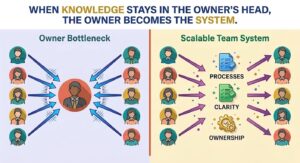
Before long, the owner is needed in the middle of everything again.
Why Relationships Still Matter
Clear expectations create alignment, but relationships create engagement.
Research consistently shows that an employee’s relationship with their direct manager is one of the strongest predictors of job satisfaction. When employees feel respected, valued, and heard by their leader, they are far more likely to stay engaged in their work.
Engaged employees tend to be more proactive. They bring forward ideas, identify problems earlier, and take greater pride in the quality of their work.
Relationships also make performance conversations easier. When trust exists between a leader and their team member, feedback is less likely to feel like criticism and more likely to feel like coaching.
This does not mean leaders must become best friends with everyone on their team. But employees do need to feel that their contributions are recognized and that their voice matters.
Clarity defines expectations. Strong relationships create the environment where people are motivated to meet them.
Why Ownership Expands When Employees See a Future
Employees rarely feel strong ownership over work that feels transactional.
When people believe their role is simply to complete tasks assigned by someone else, they tend to do exactly that. They finish the task and move on. Initiative stays limited because the work does not feel personally meaningful.
Ownership grows when employees can see how their work connects to something larger than the task itself.
While founders naturally focus on company growth, employees are often thinking about their own growth. They want to know whether they are developing valuable skills, increasing their capabilities, and moving toward meaningful professional progress.
When leaders take the time to connect those two paths, something powerful happens. Employees begin to see their work not just as a job, but as part of their own development.
They feel invested.
When employees feel that their growth matters to the organization, commitment tends to increase. And when commitment increases, it becomes much easier to build the trust and ownership that high-performing teams require.
Clarity helps employees understand what success looks like. Alignment helps them care about achieving it.
The Performance Formula That Changes Everything
Team performance in a growing business can often be simplified into a single equation:
Performance = Clear Communication × Trust × Ownership
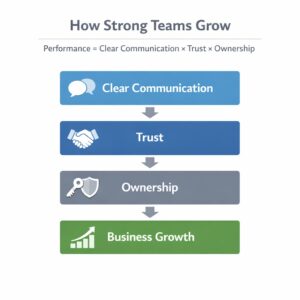
When communication improves, employees gain confidence because expectations are clear.
When expectations are clear, trust increases between the leader and the team.
As trust grows, leaders become more comfortable delegating outcomes rather than micromanaging tasks.
Ownership expands.
And when ownership expands across a team, the business gains momentum without the founder carrying everything alone.
Where Many Owners Start When They Want to Fix This
When a business begins to feel stagnant, many owners immediately look for external solutions. They consider hiring new people, launching additional marketing campaigns, or introducing new services in the hope that something will unlock growth.
Sometimes those strategies are necessary. But they are rarely the first place leaders should look.
Instead, it often helps to step back and examine three foundational questions.
Are expectations for each role clearly defined in terms of outcomes rather than tasks?
Do employees have access to the information and processes they need to make decisions without constantly asking the owner for guidance?
And do team members see a path for their own growth within the organization?
When these elements begin working together, something important changes inside the business. Owners find themselves pulled into fewer operational decisions, employees take greater ownership of their roles, and the organization begins moving forward with more consistency.
Growth rarely comes from a single dramatic change. More often, it comes from improving the clarity, structure, and alignment that allow a team to perform at its best.
Common Questions Small Business Owners Ask About Stagnant Growth
Why do small businesses stop growing?
Small businesses often stop growing when too much operational knowledge lives only in the owner’s head. When expectations and decision frameworks are not clearly communicated, employees tend to focus on tasks rather than outcomes, which slows progress and keeps the business dependent on the founder.
Why do employees seem less capable than the owner?
Business owners see the entire picture because they built the company. Employees usually see only their portion of the work. When expectations and standards are not clearly defined, employees may complete assignments without fully understanding the broader outcomes required.
Why does my business still depend so heavily on me?
Many founder-led businesses rely heavily on the owner because the owner’s standards and decision-making processes have not been translated into systems the team can follow. When those expectations become clear and consistent, employees can begin making decisions independently.
How do you get employees to take more ownership?
Ownership increases when employees clearly understand what outcomes they are responsible for and how success will be measured. When leaders define expectations, provide structured feedback, and allow employees to solve problems rather than simply execute tasks, accountability naturally grows.
Clarity and Alignment Are Growth Strategies
Small business stagnation is rarely caused by a lack of effort. Most founders work extraordinarily hard.
The challenge is that effort alone does not scale a company.
Clarity does.
When expectations are explicit, ownership expands. When ownership expands, execution improves. And when execution improves across an entire team, the business begins to move forward again.
For many small business owners, the breakthrough they are searching for is not a completely new strategy. It is translating what already works in their head into systems their team can consistently execute.
Clarity and alignment may seem simple, but they are two of the most important growth strategies a small business owner has.
Leave a Reply